
Books have always been an important source of entertainment, knowledge, and cultural preservation since the beginning of human history. However, the way we consume books has evolved significantly with technological advancements.
Today, readers are no longer limited to traditional printed books. With digital advancements, formats like ebooks and audiobooks have become increasingly popular, as they provide convenience, flexibility and accessibility for readers. But with so many options available, a common question arises: Which format is actually better, audiobooks vs ebooks vs printed books?
In this guide, we’ll discuss each format and compare their pros and cons, to help you decide which one suits your lifestyle best.
Audiobook vs Ebook vs Print Book Comparison Table
Before we discuss each of the formats in detail, let’s take a quick look at how they compare.
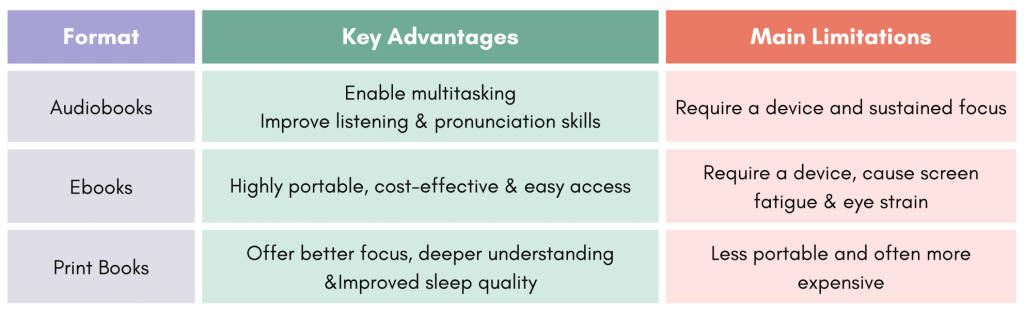
Now, let’s explore each format in detail to better understand the advantages and limitations of audiobooks vs ebooks vs printed books.
Audiobooks
An audiobook (or “talking book”) is a recording of a book being read aloud. It allows listeners to experience a story without physically reading the text.
Although audiobooks have gained massive popularity in recent years, their origins date back to the 1930s when they were created for visually impaired individuals. Initially available on vinyl records and later cassette tapes, they have now evolved into easily accessible digital formats.
Pros of Audiobooks
- Allow multitasking
- Help improve pronunciation and listening skills
- Reduce eye strain
- Accessible for people with dyslexia, visual impairments, or anyone who finds reading text challenging.
- Sound effects and narration enhance storytelling
Cons of Audiobooks
- Require electricity and a device
- Easy to lose focus or get distracted
- Not suitable for books with images or diagrams
Who Should Choose Audiobooks?
Audiobooks are ideal for:
- Busy professionals
- Travellers
- Individuals who find reading text challenging.
Ebooks
Ebooks are digital versions of printed books that can be read on devices like smartphones, tablets, or e-readers. Many ebooks come with added features like adjustable fonts, bookmarks, and built-in dictionaries.
Pros
- Highly portable, you can carry an entire library in one device
- No physical storage required
- More environmentally friendly
- Usually cheaper than printed books
- Instant purchase and access
- Customizable text size, font, and brightness
- Searchable text and built-in dictionary
Cons
- Screen exposure can cause eye strain
- Require electricity and devices
- Notifications and apps can be distracting
Who Should Choose Ebooks?
Ebooks are best for:
- Students
- Travelers
- Budget-conscious readers
- People who prefer convenience and quick access
Printed Books
Printed books, often referred to as paperbacks or hardcovers, are the traditional format of reading. Despite the rise of digital formats, they continue to hold emotional and cultural value for many readers.
Pros of Printed Books
- Provide complete focus with no digital distractions
- Do not require electricity or devices
- No exposure to blue light (better for eye health and sleep)
- Enhance concentration and retention
- Help preserve literature and culture across generations
Cons
- Less environmentally friendly
- Often more expensive
- Can be damaged, lost, or misplaced
- Take up physical space
Who Should Choose Printed Books
Printed books are perfect for:
- Readers who want better focus with no distractions
- Book lovers and collectors
- Students studying complex subjects
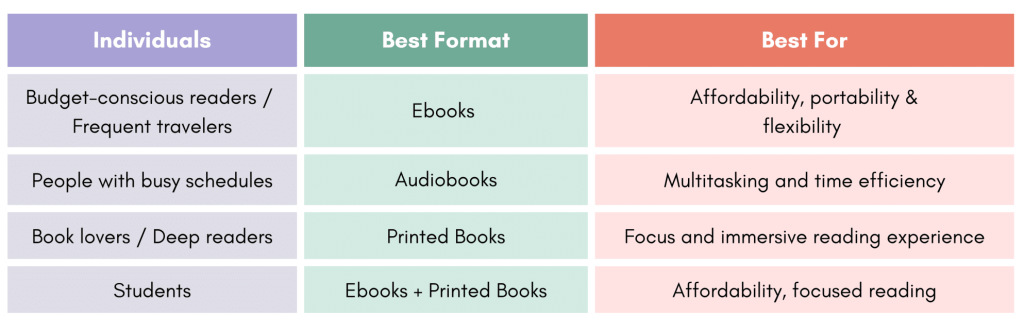
Choosing the Right Format
Each format offers unique advantages.The right format depends on your lifestyle and personal preferences. To make it easier, here’s a simple breakdown:
Ready to start reading? Discover a diverse collection of ebooks and printed books on Mera Qissa Bookstore.
Conclusion
Every book format performs best according to specific needs and requirements. Whether it’s an ebook, a printed book, or an audiobook, each format delivers the best experience when it is chosen based on the purpose it is designed for.
Printed books have always created a deep emotional connection between the reader and the story. They have served as a powerful source of preserving literature across generations and they will continue to do so.
Ebooks, on the other hand, have made reading more accessible and convenient. With their affordability and portability, they have adapted perfectly to modern lifestyles, offering a practical alternative to traditional reading.
Audiobooks, rather than replacing these formats, have expanded the way people consume books. They have increased interest in reading by catering to unique needs, such as individuals with reading disabilities and those who want to read but struggle to find time in their busy schedules.
Therefore, it is fair to say that there is no single best format when it comes to reading, each format performs well in its own way. The right choice ultimately depends on the reader, what suits their specific needs, lifestyle and preferences. So, instead of sticking to just one format, readers can explore all three and discover how each one adds value to their reading journey.
FAQs
1. Why do people prefer printed books?
People prefer printed books because they offer a distraction-free experience, better focus, and a deeper emotional connection. Many readers also enjoy the physical feel and tradition of holding a book.
2. Are eBooks replacing printed books?
No, eBooks are not replacing printed books completely. While digital reading is growing, many readers still prefer printed books for their focus, comfort, and emotional connection. Both formats continue to coexist.
3. Can audiobooks help with dyslexia?
Yes, audiobooks can be very helpful for people with dyslexia. They allow individuals to enjoy and understand content without the challenges of reading text, making learning more accessible and enjoyable.
4. Are audiobooks as effective as reading?
Yes, audiobooks can be just as effective for understanding and enjoying content. However, for deep learning or studying, printed books or ebooks may offer better focus and retention.

