It is true that political, social or religious differences must be accommodated. Borders are drawn to avoid conflict and allow people to live in a peace. Geographical divisions may seem like a progressive idea today. However, decision makers do not and can not speak for all people. Amidst these divisions, ties of love, friendship and generational attachments have to be torn. These barbed wires that mark borders, scratch and wound those who have to cross them over.
We can’t possibly mend the 73 year old political enmity, but we can surely rise above these institutional differences and talk about our narrative. The narrative of the marginalized ones. Perhaps the most marginalized in the division of sub-continent were all those whocould not cease to love and feel for their lost comrades.
An Attempt at making Peace Across Borders
To establish and spread the narrative of the literati in both countries, Daastan from Pakistan and White Falcon Publishing from India, initiated a Letter writing movement. We invited writers to send in their letters to express their concerns for regional peace. Writers could write in prose or poetry. Daastan received letters in Urdu, English and Hindi, following the main theme: regional peace.
Our Contribution
We, atDaastan, received letters from all across Pakistan. We were amazed by the energetic response by the talent in our country. All these letters were extremely emotional and beautiful. Our team was deeply touched by the effort put in by the talented writers from all around Pakistan. The aim behind this movement was to simply acknowledge the fact that no matter how these divisions have shaped our history and geography, love and friendship can break all walls. These letters and their writers are legitimaterepresentatives of peace from both countries. The powerful voices that echo from our television screens, can not mute the narrative of peaceful co-existence.
Chitthi Sarhad Paar Sey
The best letters from the numerous entries were compiled in a book titled ‘Chitthi Sarhad Par Sey“ . It is available on MeraQissa. You can read the book here.
We aim to keep connecting readers and writers in an attempt to grow and engage in literary activities. If you share our love and passion of literature, sign up with us at Daastan and let us grow together!
Taking forward our theme of ‘The Art and the Artist – Writing a Book“, We are back with the Live session of Mused! The positive response that we received on the first episode was a great motivation for us to bring to you, more fun, informative and useful content that will help you with Book writing. This episode was divided in three sections. Our host, Summaiya Naveed, shared some practical tips on enhancing your writing skills. If you missed the live session, don’t worry, we’ve got you covered. Keep reading this blog to get a summary of the entire session or just click here to watch it now!
Mused is Daaastan’s first Live Show, featuring Ms. Summaiya Naveed, Editor Daastan
What we discussed
In this Live session, there were three main concerns that Summaiya put forward. All of these issues highlight the difficulties faced by young authors in writing or publishing their books. The first segment dealt with:
1. Common Mistakes In Book Writing
In the first section of this episode, Summaiya talked about the common errors that most writers make while writing a book. First and foremost is the issue concerning tenses. While writing anything, we are usually taken aback by a stream of emotions. This diverts our attention from using proper tenses. Very often, you keep shifting from one tense to another which then affects the story. To avoid this, you must make a conscious attempt to keep proof-reading the story over and over again to alter any such errors.
The second mistake pointed out was regarding plot holes. Summaiya explained the concept of plot holes in detail. She defined them as any gaps that a story-line leaves which consequently fails to make sense of the story to the reader. This plot hole could be a hanging conclusion, a half-baked character or even introducing a new character mid-story and failing to weave them in with the rest of the story. Summaiya also highlighted that plot holes count as a weak story-line which again, leaves a bad impression on the reader. To keep your story strong, make your protagonist and each supporting character reach a conclusion. Any story-line left incomplete will weaken the weight of the plot of your story. To fix this mistake, she suggested we emphasize on important events in the story. Summaiya gave the example of the novel, ‘Hunger Games‘ in which, the ending of each chapter marks an important event. In this way the reader can predict an upcoming event and brace themselves for it.
Lastly, summaiya talked about flat characters and a robotic tone. Both of these mistakes are almost the same, as they involve a lack of insight into the world of your story. A robotic tone, summaiya explained, is flat, factual writing. By stating events of a story or attributes of the character it is hard to keep the reader glued. The reader wants to know where exactly is the story coming from. Providing descriptions that a reader might relate to will help them connect with both, your story and the characters.
2. How to fight Writer’s Block?
Writer’s block is a temporary condition when an author loses the ability to produce creative content. Summaiya explained in detail, that writer’s block is not permanent and does not mean that you can never write again. A lot of writers do not talk about their writer’s block due to the stigma attached. This does not help them, rather adds to their stress and anxiety. Another reason for writer’s block is neurological disturbances. By sharing a recent research on writer’s block, Summaiya pointed out that stress, anxiety or other neurological problems trigger the writer’s block. To fight this situation, it is important to maintain your mental and physical health. Talking to friends, family or fellow writers at literary groups on social media will help you overcome this phase and resume writing.
It is also helpful, Summaiya suggests, to not be hard on yourself and take a break. During this time, explore another creative activity that you might find interesting. Writing freely, without any limitations or requirements may also help in this case. Sometimes, we are unable to write because we have to constantly follow guidelines. Writing for yourself, with no set rules or fear of criticism can help you fight a block. For some people, making changes to their surroundings can also be refreshing. Change your daily routine, fix your cupboard or just treat yourself with your favourite food!
A lot of people have this pre-conceived notion that writers are sad, depressed souls who have climbed an Everest of tragedies. Young authors thereby are particularly inclined to feel sad and unhappy in an attempt to become better writers. It is however, only a misconception that all good writers are unhappy people. Mental health is a very important factor in improving your writing skills and tackling a writer’s block.
3. Why do Books get rejected by Publishers?
Another problem faced by a lot of new writers is rejection by publishers. It is important to know why publishers reject your work and what are they looking for? Summaiya puts it in a very simple way for us to understand.
1. Predictability of your Story
Firstly, she talked about predictability of your plot/story. A very basic story is one where the upcoming events are quite obvious, everything goes smoothly and all characters reach a happy conclusion. Such stories become quite tedious and monotonous. A story has to have something that keeps your reader gripped, curious and connected.
2. Misuse of Punctuations
Secondly, bad punctuations is a big issue for editors. The first thing a publisher will notice about your book is technical errors. If you have a badly punctuated structure, you instantly leave a bad impression. To fix this problem, summaiya suggested we revise our punctuations and read as much as possible to learn.
3. Inconsistency and Lack of Innovation
Third and equally important, Summaiya discussed the problem of inconsistency and lack of innovation. She explained how as an editor herself, she comes across a lot of manuscripts that look very promising in the beginning but get de-tracked mid-way. Either the writer loses inspiration to write and just rush to the end of story, or they start dragging events by adding too much unneccesary details and the reader’s interest is lost. Furthermore, a lot of writers refrain from exploring new techniques or ideas and simply follow a pre-existing linear timeline. To explain this point Summaiya used the phrase “Old is not gold in writing”. By this, she meant that readers do not want to read about the same topics or stories over and over again. She also urged writers to write on relatable topics that are relevant today.
4. Plagiarism
Last, but definitely not the least, came the issue of Plagiarism. In countries like Pakistan, there are very weak rules and regulations regarding intellectual property. In such countries, intellectual theft and plagiarism are big drawbacks for writers. Plagiarism is basically stealing someone’s content and using it as your own. It is a crime to steal someone else’s work and also ethically incorrect to do so. While most of us do not directly steal ideas, we take inspiration from a work and fail to give credit to that particular person. It is thus important to provide a reference of whatever you’re taking inspiration from. Facts, data or information that you use in your own research should also be cited or quoted.
This wraps up our second Live session of Mused. We hope to keep bringing new, informative episodes to help you with writing. If you share our passion of writing and want to contribute in this mission to develop the literary Industry of Pakistan, sign up with us at Daastan. Stay tuned and catch the next Live session this week!
It all started when Professor Pervez Hoodbhye wrote an article on Dawn titled ‘Corona – our debt to Darwin’ where he was raising this point that how biological science is the hope to control this Corona pandemic.
Thanks to biological science — the foundation of which was laid by Charles Darwin — the coronavirus will eventually turn out to be a deadly but controllable affair. Its final worldwide death toll may run into many tens, or perhaps hundreds, of thousands. Still, compared to the toll exacted by pre-scientific era plagues, this will be small. Your life may well be saved by some yet to be invented drug or vaccine. All beneficiaries of modern medicine should surely forgive Darwin for his supposed transgressions.
What’s promising about Hoodbhye is that he uses science, logic and objectivity to look at the things rather than claiming that religion will somehow solve things. He tries to educate an illiterate nation who trolls him a lot on his social media page. However, he continues to do the good work.
The Logical Criticism on Hoodbhye
Today, was somewhat different. We came across someone who went after Hoodbhye with scientific facts and tried to prove him wrong. His name was Daniel Haqiqatjou who provided detailed arguments on how and why he believes Darwin’s theory to be obsolete. He referred to various researches, scientists and researchers who share his beliefs. This debate was in light of the current Corona Virus situation. According to Daniel Haqiaqtjou, as a Muslim, he firmly believed that any such evolutionary change can only be God’s work and must only end with His will. Here is the original post he shared:
Pervez Hoodbhoy Fails in Science and in IslamHoodbhoy, the Pakistani secular modernist, has taken this opportunity of …
Under his post, Arif Jan wrote a long reply which refuted Haqiqatjou’s argument on the redundancy of Darwin’s theory. Arif provided a counter argument, equally well-backed, loaded with references of books, researches and studies to prove otherwise. In his opinion, Haqiqatjou only picked references that went along his own claim. Have a look at Arif Jan’s counter argument in a post shared by Syed Muneeb Ali:
There was this article written by the Daniel Haq.. In which he tried to counter Dr. Parvez Hoodbhoy's recently written…
We would leave that to the audience who can read and decide who is right. What we loved was that how an argument was formed, refuted and countered with facts. This is the kind of evolution we wish to see on social media.
Remember that whenever you post anything online, it reflects you and the way you think. Validity of news and researching the facts before arriving at conclusion is the need of the hour. Corona Virus is rattling the global economy and we have no idea how much more damage it will do. One thing which we, as individuals can do is backup everything we say or post online with facts.
Another key thing which we loved was that the discussion was civil and to the point. The speakers spoke based on their scientific intellect and understanding. This debate is a fine example of how to argue online and turning these virtual battlefields into healthy and informative platforms!
If you’re anything like us and are obsessed with Pakistani literature, you have heard of the latest controversial buzz in the literary community. We’re calling it the “Moon Controversy” because of the similar use of the word “moon” in two book titles– Noor Unnahar’s ‘yesterday I was the moon” and Khizra Zaheer’s “the moon has my heart“. In this case, the author of “the moon has my heart” has been accused of stealing concepts and content from Unnahar.
In the past week, things have unfolded with quite a twist: the publishers of said plagiarized book have issued an official statement; Unnahar has talked about the scandal on both her Instagram and her Facebook; and now Khizra Zaheer, the author of the book said to be plagiarized, has come forward with what she has to say about it all.
Asalam u A'laykum All ! We at Auraq take copyright issues very seriously and we firmly stand against the plagiarism in…
While writing a comprehensive article on just how such an event came to be, Daastan reached out to Ms. Khizra Zaheer to ask how she would like to address the situation. She responded with a detailed explanation.
Khizra Zaheer’s Official Statement
“First of all my new book (the moon has my heart) is crafted with all the hard work, time and efforts including cover that is neither plagiarized, copied, burgled, robbed or theft by any other book. In the past two days, the issues that were raised for my newly launched book cover (the moon has my heart) were totally baseless and senseless.
The author of the book (Yesterday I was the moon) instead of contacting directly with me or my publisher regarding her concerns, she preferred to post about her concern/issue directly on the social media platforms. And being the influencer she had used all the platforms to put false claims of plagiarism and allegations on me and Auraq Publications without having any evidence of it. These postings at her social media accounts and all other social groups had brought me a lot of damage and defame to me with abusing and this intensely had hurt my credibility that I have earned professional field in both local and international industry in over ten years. Seriously it takes a lot of years to create credibility and people demolish it within a fraction of seconds even without proofs. Though Auraq Publications have offered her to have a copy of my book (the moon has my heart) for proper understanding of the book but she denied to have it.
Through your platform [Daastan], I want to say that if you really want to see the truth and factual based stuff then do check out the images and link attached at Facebook and Instagram pages of Auraq Publications or at my Instagram handle @khizra.zaheer.
The analysis of both books are keenly and carefully tested and analyzed by renowned industry experts and NCA professional designers. It’s my humble request to you all for future that without seeing the real image and verification don’t put your words in everyone’s mouth else it will bring lots of damage. People abused, accused and alleged me for the whole senseless dramatic story.
Also just to clear, the MOON is universal object and can be used by anyone while the concept of both book titles are totally different (the moon that is a part of yesterday with the cut of lines, yesterday I was the moon while my new book concept is revolving around the moon that has my heart).
The attached images and all stuff under the link of Our official pages will give a real peace to all people’s hearts and souls who have put worst allegations on us. So it’s to clear you all that the font, color, layout, style, blueprint, background, images and content are neither copied, stolen, theft, robbed and burgled nor violated any COPYRIGHTS of any book. I am really very thankful to Auraq Publications that have greatly supported and tackled the issue in a better and thoughtful way.
However, for more understanding of the inside content, where I put my heart and all the efforts, you can order my book directly so you can know well before blaming someone that what I have originally put in it.
Note that we reserve all the rights, including legal notice, to proceed and act if the humiliation and assassination continues. Thank you!
What do you think about this?
Zaheer firmly claims that no part of her book– concept, content or layout– is plagiarized and her book is the result of her hard work and efforts. In the light of everything that has unfolded, it seems to come as a surprise that the author has taken a strong viewpoint and is denying all accusations made against her. What Unnahar or the rest of the community has to say about this is still not known.
If you want to check out the evidence the author has talked about, you can click here. Let us know what you think about the #mooncontroversy in the comments below!
In a time where copies and duplicates make up a big part of any industry, originality is a rare feature of a work, appreciated by those who understand what it takes to create something unique and independent. Like in any other community, time and again, the literary world has been shocked by the surfacing of plagiarism: the 1978 Roots scandal or more recently the speech made by First Lady Melania Trump which turned out to be Michelle Obama’s are quiet some examples.
Plagiarism is the “unauthorized use or close imitation of the language and thoughts of another author” (HEC); an act of stealing all or parts of someone’s original work and passing it off as one’s own. Basically, it means to take credit for that which an individual has not personally created. It is a practice that the literary community is riddled with but one which is seriously frowned upon by readers and writers alike.
Plagiarism – A Crime
Sadly, in Pakistan, there is a lack of action taken by the authorities when it comes to plagiarism. It seems that the focus is mostly on research works and theses: since 2007 approximately 80% of all plagiarism cases regarding research works were solved. The literary industry, however, suffers still.
Not only is plagiarism a social evil but also has legal consequences. Again, in Pakistan, the law is more concerned with academic plagiarism than literary plagiarism. It involves dismissal or rustication for teachers and students, respectively. A literary author, however, runs the risk of defamation, blacklisting, rejection from publishers for all future works and more.
How Daastan handled Plagiarism Cases?
As a publishing house based in Pakistan, we at Daastan have had our share of dealing with cases of plagiarized works. In most cases, writers copy another work, word by word; in others, we see extensive use of the thesaurus. For the latter kind, it takes a sharp eye and a detailed read to weed out manuscripts that are unoriginal. A “plagiarism check” is an essential part of our editorial process; our editors judge a manuscript by its ability to stand on its own, without the help of outer influences.
While there are no qualms about being inspired by other writers (some of the best works are born that way), we strongly oppose the practice of plagiarism in literature. The beauty of literature is the perspectives it offers to readers. Behind that perspective is an author’s hard work, research and dedication. When works are copied, that hard work is disrespected. We, as a community, stand firmly against that.
The Noor vs Khizra scandal
Recently, the plagiarism incident of a book titled “The moon has my heart” has been making waves across social media platforms. It has induced the anger of the literary community as a whole but has also split us in “for” and “against” teams.
On the 27th of December, 2019, a local publishing house launched a poetry book titled “The moon has my heart” written by the Instagram influencer and poetess Khizra Zaheer. The book was in the works for some time: pre-orders, cover launches and giveaways were all set to go. On the website, the book was said to be “a rich and beautiful collection of poetry about life, love, loss, inspiration, hurt, strength, nature and family”. The author herself was receiving praise from her readers on the accomplishment of a second poetry book.
Some readers, however, noticed that the book cover for “The moon has my heart” was very similar to another book. This was the generally acclaimed poetry book “yesterday I was the moon” by Noor Unnahar—a talented 22-year-old writer who has been published by Penguin Random House. Her book “yesterday I was the moon” has received much praise from readers and critics and the book cover has won a design award by the New York Book Show!
The similarities didn’t end here. Readers who bought the book confirmed that the inside layout as well as parts of the book were copied off of Unnahar’s book. One reader said, that “most of the book was badly plagiarized. Original poems had terrible grammar. Others were heavily inspired from Noor’s book”.
The literary community came forward as a united front, dug deep and recognized the similarities between the launch ceremonies of the two books as well. Whereas another reader threatened the publisher for legal action.
cannot believe a publishing house published a heavily plagiarised book. khizra's book looks like a cheap knock off of…
While there were those who stood firmly against the blatant plagiarism and called out the publishers, some readers took a different perspective. A group of writers insisted that the book was actually not plagiarized. The book cover bore a resemblance to “yesterday I was the moon” but the content inside was different. Others argued that because it was only similar to Unnahar’s work and not exactly a copy, it did not come under “copyrights infringement”. More still, came out in support of Khizra Zaheer.
The majority, however, lay with those who did not consider this a mere coincidence. Noor Unnahar, herself, took to Instagram to talk about the case. She said,
“I was informed that the cover of my book, along with the layout inside, was copied by an author. I knew them, had interacted with them when they needed help with publishing their first book.” She also said that she was, “heartbroken” but that the “support that came from the writing community has been splendid. Together, we reached the publishers of the book in question to take it down.”
The evolution of publishing industry
The support that Noor has seen on part of the literary community tells us how far we’ve come. 5 years ago, Daastan started as a publishing company, hoping to revive the dying literary industry of Pakistan; to put in our part in its rejuvenation. Seeing the kind of ferocity that the readers of Pakistan have defended an author’s work with, we are convinced that that revival is well on its way.
The community has evolved to expect the best and the original: where once, this incident might not have invoked such a strong voice on part of the readers, today it has resulted in the authorities taking action. Auraq publishers have taken down the book “The moon has my heart” from their website and further action is expected. When approached, they told us they had issued an official statement regarding the matter. The author, Khizra Zaheer, was also asked to address the situation and has recently issued her own statement through Daastan. You can read what she has to say here.
Asalam u A'laykum All ! We at Auraq take copyright issues very seriously and we firmly stand against the plagiarism in…
At the end of the day, however, when it comes to the standard that has been set for the publishing industry in Pakistan, it’s refreshing to see what the literary community expects of us: honesty and transparency.
Daastan always strives for excellence in publishing: from our team of editors who work tirelessly on manuscripts, to our readers who keep us on our toes, we are taking this journey for the revival of Pakistani literature, step-by-step. Join us today and help us revive the literary Industry of Pakistan!
Among the most fearless, most resilient creatures on earth are the soldiers of a country that fight and bleed for the protection of their beloved homeland. Over the course of 72 years, Pakistan has been no stranger to war. Today our history books are filled with countless sombre and often gruesome yet heroic accounts of our brave soldiers. We hear about them from our grandparents, watch and read through their lives, priding in their bravery; basking in their glory. One such story is that of Maj. Aziz Bhatti.
The Tale of Maj. Aziz Bhatti
One such life story is of the receiver of the Nishaan-e-Haider, Major Raja Aziz Bhatti Shaheed. His is a name familiar to every man, woman and child of Pakistan. He is a national hero; an awe-inspiring leader who led a limited number of soldiers to carry out a fiercedefense of the Burki area of the Lahore sector in the 1965 war with India. Despite being outnumbered and under unceasing fire from the enemy, Maj. Aziz Bhatti launched a strong, impenetrable defense against the Indian Army. Dismissing offers to rest or even see his family members in Lahore, our hero soldiered on. During an intense exchange of artillery fires between the two armies, he was hit by an enemy tank shell and embraced Shahadat.
The valiant soldier stood undaunted in the face of the raging enemy and laid down his own life to protect countless others.
Bringing his Story Back to Life
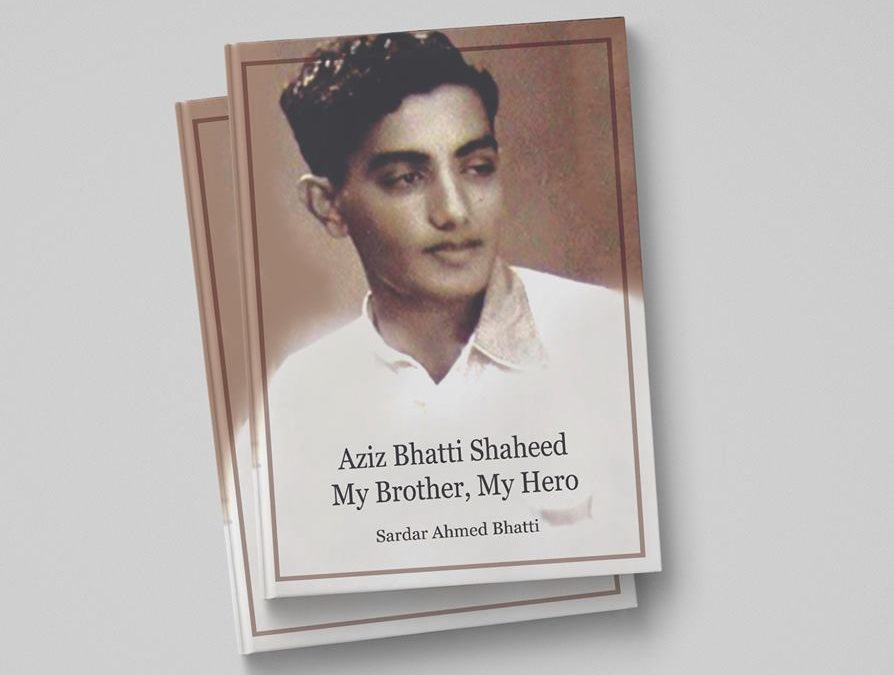
This is the aspect of his courageous story that we are familiar with. But what most don’t know is who Maj. Aziz Bhatti was, without the title. Who he was as a person, a son, a friend. When, earlier this year, his brotherSardar Ahmed Bhatti reached out to Daastan with the intention of publishing a biography he had written about his brother, we were honored to be chosen for the task. Written from the perspective of a loving brother, the book gives an insight into previously unknown events of Maj. Aziz Bhatti’s life, his relationship and closeness with his brother, his life in Hong Kong as a boy before and during World War II and several unpublished, memorable pictures.
Daastan’s Role
As a platform bent towards literary revival, Daastan strives to bring lost stories to life; stories that are worth being told and preserved. We are proud to be the means of bringing forth this heart-warming account of Maj. Aziz Bhatti’s life away from the border, to the public. The book titled “Raja Aziz Bhatti Shaheed: My Brother, My Hero” is available on Qissa’s website and has received over-whelming responses and appreciation from all over the country on our social media.
Book Launch
To honor the story of Pakistan’s son, a book launch ceremony is being held on the 12th of September from 14:30-17:30 at the Pakistan Academy of Letters, hosted by Daastan. On this Defence Day, as we look back to the lives of our warriors, let us seek inspiration from their courage and glean wisdom from their actions. Join us on the 12th to remember the sacrifices Maj. Aziz Bhatti has made for the protection of this beloved homeland. As we stand with the Shaheed’s family, we stand united under the slogan that kept him standing for so long, holding his own– unbroken, relentless–in front of the enemy: Pakistan Zindabad!
You can order your copy of Raja Aziz Bhatti Shaheed: My Brother, My Herohere.