Good writers are always known for their writing skills. Many writers have tremendous stories to tell but only a good story-teller with a polished writing style will find their way to the reader’s heart. The Pakistani publishing industry is growing at an incredible pace. However, as publishers, we come across beautiful stories that lack communication and skill. It is always the hardest task to reject a brilliant story that is not well-written. For this very reason, Daastan has worked out a perfect plan for you to improve your writing skills! Grab a pen and paper, and start the exercise today!
Your Go-to ‘Writing Skills‘ Work-out Plan!
1. Warm Up the brain!
Your mind needs experiences to store new information. Human beings learn from the social memory that they build through interactions with others. Your writing skills require the same warm up. Read! Before jumping off to experimentation, make sure you have the required equipment. Read as much as you can and learn different writing techniques. Reading more will help you differentiate between a good book and a boring one. Identify what keeps you glued to the book and then use that trick to catch your reader. Is your brain active enough now? Great, because its time for you to jog!
2. Onto The Jog..
This is your time to build up that stamina. Hold on to all you have gathered from reading and start applying. Begin with the grammar skills. Tiny mistakes can leave a lasting impression. Your warm-up stage will help you a lot here. Since your memory is fresh with the reading, you are exactly at the right jogging track! (Pun intended) Secondly, don’t forget to look out for your imagination. Your reader needs to explore the universe created within your story. For that, you need to explore it first. Map out your story, characters and situations. Measure each tiny detail intricately. You are the creator of your story. Make sure you leave no loopholes. If you begin with an idea in your story, do not leave it hanging. Reach a conclusion and inject it into your reader.
3. Squat Out Your Expression!
Learning to write well? Why not show it off? Once you have a grip over your grammar, its time to pull the reader deeper into your universe. Work on your descriptions. Talk about each and everything you can to paint the most realistic image. Use your creativity and characterize your surroundings. Make the reader immerse themselves in your story. If you talk about the wind, describe how cool or hot it is. Is it dancing or swinging softly? Use the auditory senses and talk about the whistling sound your wind is making. In short, let your reader feel and view what they are reading.
4. Stretch And Chill
The last stage of your exercise is the most crucial one. You can’t leave your warmed-up body just like that. You need to stretch and let it cool down. Similarly, your draft needs stretching. Proof read your text over and over again. Check for spelling errors, grammatical mistakes and discard any unnecessary details. The more you read your draft the better you can fix it. Imagine being the reader and explore your story. Make the most of this stage because once you publish or submit your manuscript, you immediately leave your impression.
Great Job, your writing skills are coming in shape! Try out this easy and simple workout plan to get fit in what you do best. Once your manuscript is ready, Daastan will help you design, publish and market it. So start working out today and reach out to us for technical assistance at any time. We are just a click away!
As the last episode of Mused by Daastan aired last week, we experienced a plethora of emotions. On one hand we are sad to pause this journey of learning – while on the other, hopeful for the future. The response we gathered is inspiring and motivating enough to push us further. Have a look at what our host Ms. Summaiya Naveed had to say about this.
We started Mused with the vision to help creatives—a vision we will take forward as the series advances. For now, I hope the first season has helped aspiring writers and given them a nudge towards achieving their dreams. I’ve had a great time creating such content for you and an even better time having conversations with the viewers. You’re an inspiring lot and you give our team the motivation we need to keep putting in our part in the development of the Pakistani Literary industry. What is needed most now is work. Work to distinguish ourselves as a people of superior intellect and an awe-inspiring amount of talent. The first season of Mused leaves me hopeful that we’re talking a step towards achieving that very goal.
Ms Summaiya Naveed expressing her feelings on the last episode of Mused
A Recap of Season 1 – Mused
This season, Summaiya discussed in great detail, the issues related to writing and publishing. We started off with learning the common writing mistakes, Do’s and Don’ts of writing and errors that most writers and publishers make. Then we moved on to the state of our Publishing industry,scope for writers and the condition as well as future of the writers’ community of Pakistan. We were joined by two guests who shared their own experiences and gave useful tips along the way. We had a special episode on writing poetry– on account of the proliferation of poetry writers in our community.
What We Discused In Episode 6
1. Issues With English Language
Firstly, Summaiya shared her opinion on the use of the global lingua franca – English Language. According to her, Languages have socio-political importance. In South Asia, specifically the areas affected by colonization, English language became a symbol of status. The higher classes who merged well with the British and learned the language, associated an attitude of pride with English. We have perhaps inherited the same behaviour. Summaiya condemned this attitude and explained how languages are primarily a means of communication only. Language should not be used to claim superiority or make someone else feel belittled.
According to Summaiya, the role of English in dividing social classes has created a hindrance for those who wish to improve their language. The fear of being ridiculed for pronouncing something incorrectly keeps people away from actually learning the language. Summaiya advised us to change this behaviour towards the language and encourage people to learn in a healthy way.
2. Plagiarism
Secondly, Summaiya discussed the issue of plagiarism in great detail. First and foremost, she explained how plagiarism is a serious crime. In simple words, it refers to the act of copying someone else’s work and putting it as your own consequently, giving no due credit to the owner. This is plainly cheating on someone. It is morally incorrect and demotivating for creatives to work. Summaiya expressed her concern over the absence of laws to protect creatives from plagiarism. There needs to be a certain amount of accountability to avoid crimes like plagiarism. Publishing companies should regulate the content brought by authors to make sure it is not plagiarised.
Adieu Mused!
Daastan is proud to have shared this journey with you all. It is our mission to promote literary activities and discussions through such platforms like Mused. We hope that writers benefited from these Lives sessions and we aim to keep bringing informative content for our followers. Sign Up at Daastan and keep yourself engaged in similar content!
Intellectual theft is the act of using someone else’s work without giving them credit. While it may not seem as big an issue in a country like Pakistan, it does affect us in many ways. Recently, a National Award winning Science WriterMr. Muneeb Ali raised his voice on the issue. The sad part about his effort was the absence of any response from the media, journalists or the government, who would otherwise happily use his content for their own means. Have a look at what he had to say :
Just want an opinion (I'll delete all politically baised comments! ) I've tagged you because I value your opinion and…
Syed Muneeb Ali’s Tweet on breach of his intellectual property
Next, he made a video on YouTube, providing the video of Mr. Mubashir Lucman as proof of his claim. In the video, Mr. Mubashir Lucman was reading out the exact words from Syed Muneeb Ali’s article – portraying them as his own. Have a look at the video:
YouTube Video by Syed Muneeb Ali on Media Ethics
Fighting Issues of Intellectual Theft
In Conversation with Syed Muneeb Ali
Why do journalists feel entitled to own any content for their show? Why, in your opinion, are people not concerned with giving credit to the content creator?
Well, this is a long debate but in my opinion, the reason behind this is ‘insult’. We feel ashamed in saying “I don’t know” about things we actually don’t know. Let’s suppose if the piracy scandals of mainstream journalists got exposed and they’re entitled as the ‘content narrator’ then their audience will be in the condition of doubt and will try to seek the original content creator for a more authentic information, consequently affecting their viewership. To escape from public embarrassment, they don’t mention the author’s name and present the content as if it’s their own property.
As a writer, how do you plan on safeguarding your content in future?
Being a writer, it’s more difficult and painful for me to see my content freely distributed without my name than to make a blog story on any topic. I’m aware of the fact that media piracy happens worldwide, but the system of law enforcement is what makes a difference between the world and Pakistan. I can’t do anything to safeguard my content except creating awareness through social media. However, it’s a fact that when the source is out of reach, then you can make consumers aware of the fact and this will automatically affect the so-called reputation of the source.
What measures should law enforcement agencies/government take to ensure protection of intellectual property?
If we want to see the originality or authenticity of the content being generated by some company or a country, we’ll first research about the intellectual property protection in it. In Pakistan, where we see the content being stolen, we need to make the National Response Center for Cybercrime active in not only catching the harassment or bullying cases on social media but also in responding the piracy reports. Interestingly, in copying content both senior and junior writers are equally active in Pakistan (Here is the Equality! Ah!) but only seniors are caught because they are popular among the audience. Back in 2019, 50+ articles written by me which are originally published at DAWN news were copied to about 200+ websites which includes the websites of Hassan Nisar, Javed Chaudhary and newspaper ‘Nai Baat’ etc.
Legal Opinion On The Scandal
We discussed the issue of Intellectual theft with a Lawyer, Mr Omer Imran. Mr Omer has been an active lawyer in advocating social issues in Pakistan. Here is what he had to say on Syed Muneeb’s issue:
There are laws in Pakistan protecting IP and copyright. Under the law of Pakistan, all cases related to IP infringement (an act which carries civil and criminal liabilities) lie towards specialized IP Tribunals. Under our copyright laws, you cannot blatantly copy any original work of an author and reproduce it without credit and make a profit. (You cannot in many cases even reproduce it with credit to the original author if you are making money from the reproduction) unless you have the permission of the copyright owner.
This clearly shows how journalists, as mentioned and proven by Mr Muneeb Ali, are commiting a crime by openly using content that does not belong to them. However, neither writers nor the targeted individuals know how and when to take action.
Is Intellectual Theft Really That Harmful?
Well, yes! It is rather more harmful than stealing a material possession. A material possession will eventually run out and probably only benefit the thief. However, stealing an idea will discourage the content creator from sharing his content any further. This will consequently slow down intellectual development of an entire society. It is time for us to learn as a society, what should matter more and why. Daastan has been promoting intellectual development from the get go. It is in these collective priorities that we define ourselves. We thank Mr Muneeb Ali for raising his voice on such an important issue. We hope that our priorities and attitudes towards scholarship, ethics and morals will change.
If you have any similar experiences then write to us at merasawal@daastan.com and Sign Up to receive updates on similar issues. Together, we must change!
The month of April is national poetry writing month (NaPoWriMo). Writers from all around the world join together to celebrate the art of poetry writing. We at Daastan took this opportunity to engage our followers in a poetry chain contest. Every day, we shared a prompt verse and asked our followers to continue the verse. The next person to comment would continue thereby making a chain of poetry as a combined effort.
Selected Poetry From #NaPoWriMo
We shared prompts, both in English and Urdu language on alternate days. This activity was thoroughly enjoyed by the participants. The talent and zeal showcased everyday was commendable. The standard of poetry was beyond our expectation, leaving us in a difficult position to choose the best ones. However, we selected 2 poems from English and 3 from Urdu to feature in our blog. The selected English poems are:
English Poem #1
This crimson house with its crimson walls
Set on fire with the love calls
Is this love or just another bloodied stain?
Etched with rivers while the calm moon gazes
And the night whispers softly, lyrical phrases
Though it was bygone – forgotten
The secrets it holds, remained unspoken
Hold a prisoner inside with dusky eyes.
& me with my poems
Engulfed by unheard echoing calls
Selected English Poem from Daastan’s Poetry Writing Campaign April 2020
English Poem #2
The city is alight, with hope it’s bright
The light of its sunrise, envelopes
the darkness and fills everyone with delight
Its air is rich in music and it’s
echoed with the sound of dancing feet
Go to your window and inhale this treat
The darkest hours will pass by,
with resilience you and I will fight
Selected English Poem from Daastan’s Poetry Writing Campaign April 2020
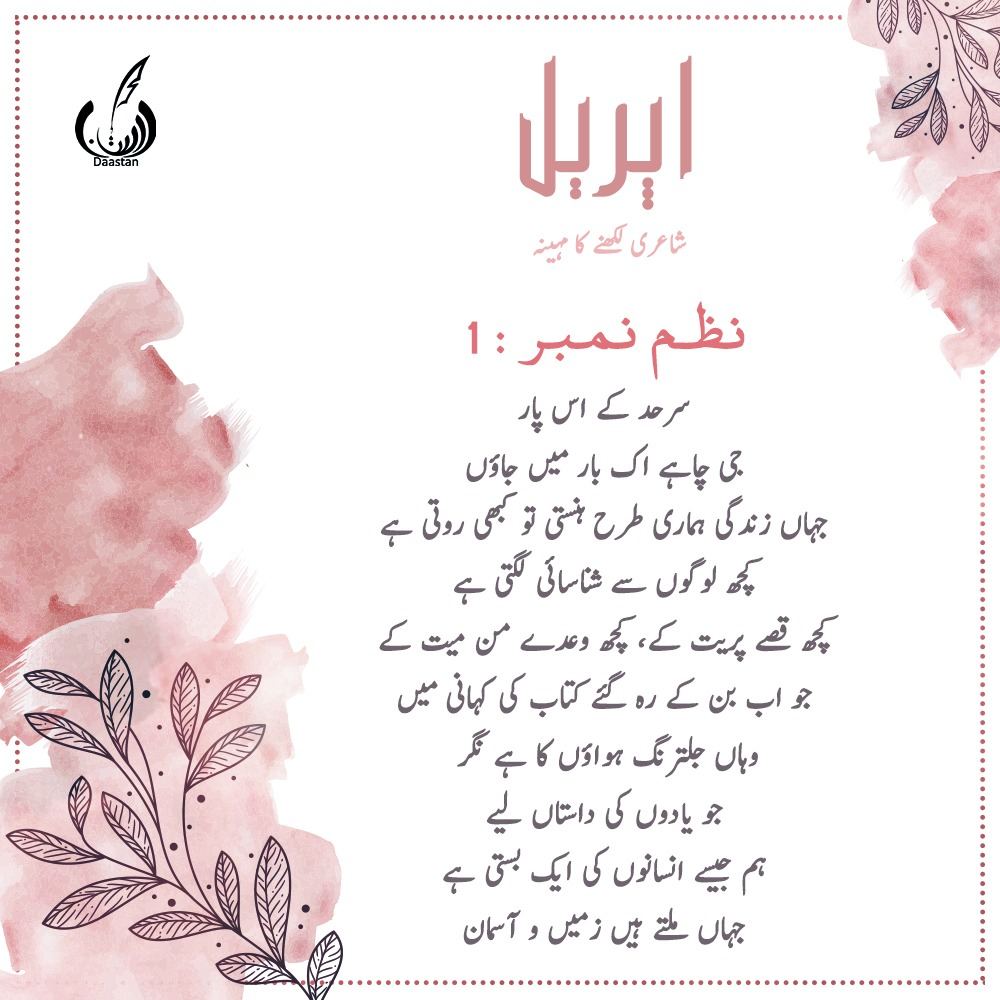
Similarly, response on our Urdu prompts was equally energetic and competitive. We chose the following 3 poems:
1 نظم / Urdu Poem #1
سرحد کے اس پار
جی چاہے اک بار میں جاؤں
جہاں زندگی ہماری طرح ہنستی تو کبھی روتی
ہے
کچھ لوگوں سے شناسائی لگتی ہے
کچھ قصے پریت کے، کچھ وعدے من میت کے
جو اب بن کے رہ گئے کتاب کی کہانی میں
وہاں جلترنگ ہواؤں کا ہے نگر
جو یادوں کی داستاں لیے
ہم جیسے انسانوں کی ایک بستی ہے جہاں ملتے ہیں زمیں و آسمان
Selected Urdu Poem from Daastan’s Poetry Writing Campaign April 2020
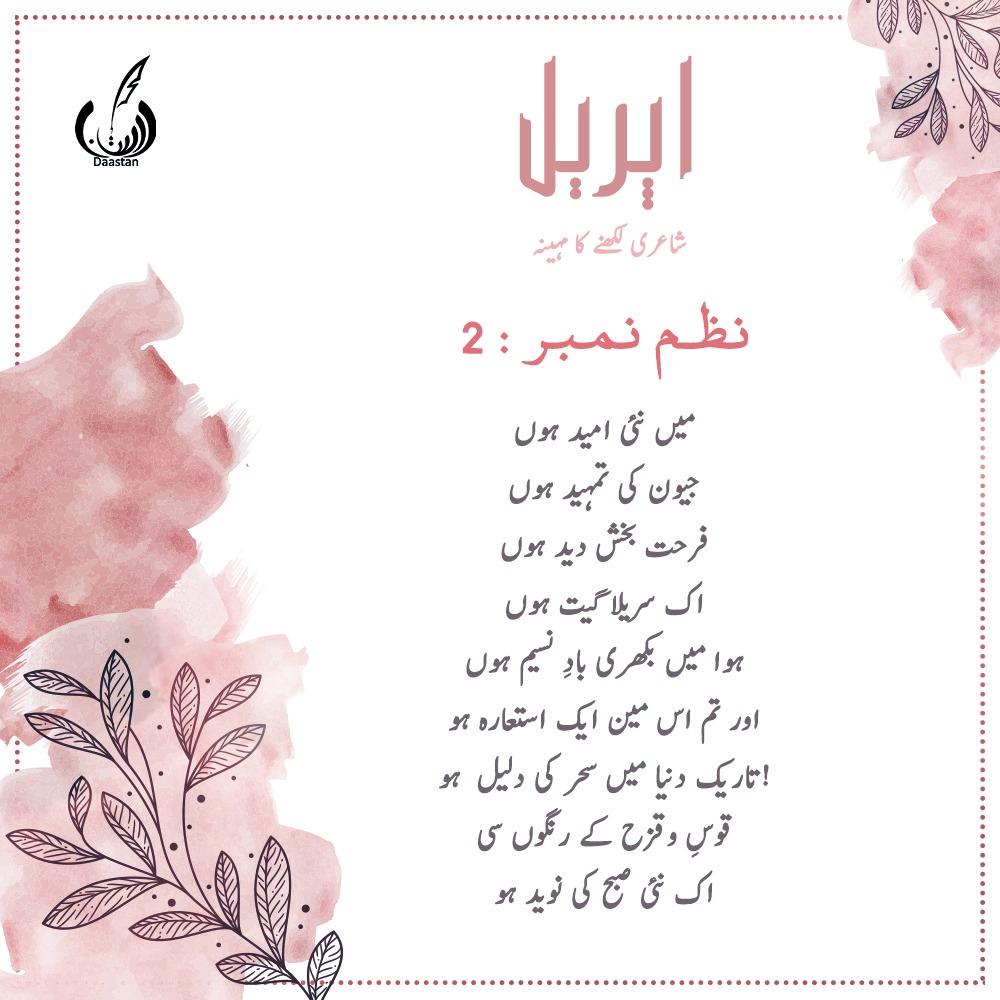
نظم 2 / Urdu Poem # 2
میں نئی امید ہوں
جیون کی تمہید ہوں
فرحت بخش دید ہوں
اک سریلا گیت ہوں
ہوا میں بکھری بادِ نسیم ہوں
اور تم اس مین ایک استعارہ ہو
تاریک دنیا میں سحر کی دلیل ہو!
قوسِ وقزح کے رنگوں سی
اک نئی صبح کی نوید ہو
Selected Urdu Poem from Daastan’s Poetry Writing Campaign April 2020
نظم 3 / Urdu Poem # 3
میری سوچوں کی پرواز کہاں تک
پنپتے خوابوں کی آواز کہاں تک
ہے میرے خوابوں کی اڑان کہاں تک
ہے شاید
تیرے نغموں کى آواز جہاں تک نیلے آسماں سے دور کہیں
اونچا اڑتے ہیں جہاں الفاظ میرے
مگر یہ بھی سچ ہے اس خاک کی اڑان کہاں تک
Selected Urdu Poem from Daastan’s Poetry Writing Campaign April 2020
Honorary Mentions For Our Poetry Campaign
We have selected Mr Obien Mayo and Ms. Amna Shah as active participants and we acknowledge their contribution to our campaign. Their active participation speaks for the love for poetry and Literature that they possess. We thank all our participants for showing interest and contributing to our effort.
Most Active Participants from Daastan’s Poetry Writing Campaign April 2020
Are you excited for our next month’s campaign? Well, we surely are! We have another interesting theme to follow in the month of May. So follow us on our Facebook and Instagram pages and Sign Up at Daastan to catch up on our monthly Literary activities!
The Pakistani writers community has long been under-appreciated. A lack of recognition, funds and opportunities have resulted in a stunted growth of our literary activities. Despite showing promise, attaining Government funds has been out of question. This episode of Mused looked at this aspect of the writers community in Pakistan. Two special guests joined our host Summaiya, in a discussion over writers in Pakistan. Their main concern was the unfortunate fact that pursuing a career in arts is still not accepted as a viable option in Pakistan.
Guests From Writers Community
We were joined by two immensely talented writers and founders of Rhizomatic Literaties, Ms Anum Sajid and Ms. Fuzeela Zubair. Anam Sajid is the Initiator and Creative Head of Rhizomatic Literaties. She is an educationist who believes in building an egalitarian book culture in Pakistan. She moreover promotes and celebrates amateur literary diversity. Fuzeela Zubair is the Project Manager of Rhizomatic Literaties. She is a book blogger. With Rhizomatic Literaties, she hopes to take a step towards expanding the reading culture in Pakistan.
Cover of Rhizomatic Literaties designed by Daastan’s design team
Anum and Fuzeela shared their experience of publishing their first book with Daastan. The writers expressed how Rhizomatic Literatiesis more than a book for them. Their book is a movement towards building a literary community and empowering young writers. Anum and Fuzeela talked about the barriers that our writers’ community has to go through. The biggest barrier, according to them, are writers themselves who shy away from publishing due to a fear of rejection. Giving the example of instagram writers, Fuzeela explained that Pakistani writers need confidence the most. Even if we are not producing good content, we should keep putting up our work to improve the standard. She believes that fear of being judged overpowers a writer. She therefore advised us to not look at writers only with the intention of criticising them.
Advice For Young Writers
Anum and Fuzeela talked about fear in writers while publishing their work. They pointed out a progress in Pakistan’s literature in terms of exploring genres like fantasy. This progress itself highlights the acceptance on part of the reading community. Anum also mentioned that our writers community does not require facilities rather opportunities. They suggested writers to write consistently. Anum explained the contribution of self-publishers in our literary space. Platforms like Qissa have played a huge role in promoting literature in Pakistan.
Rhizomatic Literaties and Women Empowerment
Anum and Fuzeela now await the second volume of Rhizomatic Literaties. This volume carries a basic theme of Female Empowerment. Their main aim behind choosing this subject is to normalize discussion on women. The book will explore how women are independent and unique in their own way. This volume will also break all stereotypes related to women and showcase their diversity. We hope that their book receives all the love and attention it deserves. Anum and Fuzeela have without doubt inspired many young authors and we thank them for their struggle in our cause.
We thank our viewers for supporting and liking our Live sessions. It gives us hope to see your positive feedback. Share your own suggestions for future discussions and write to us at merasawal@daastan.com. If you like our content, Sign Up with us at Daastan!